
Two prominent contenders in the mid-to-high-end embedded space are NXP’s i.MX 8M Plus and Rockchip’s RK3588. Both offer compelling features, but they target different applications and come with distinct architectural philosophies.
This technical comparison examines these processors from hardware, software and ecosystem perspectives to help engineers make informed decisions.
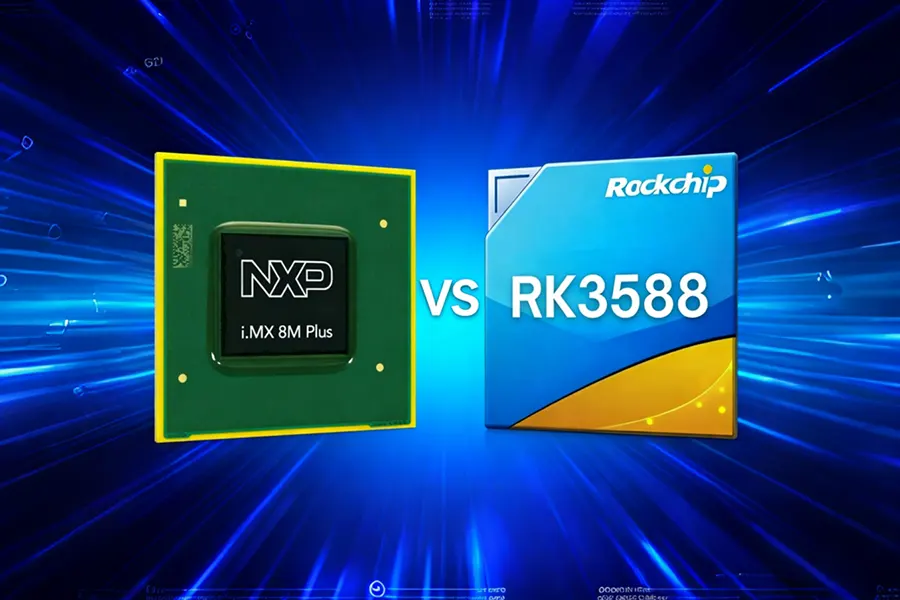
The i.MX 8M Plus is built for industrial and long-life designs. The RK3588 is built for performance: more CPU, more video, more AI. This comparison covers where they differ, so you can choose from your requirements rather than a spec sheet.
Quick answer
- Choose the NXP i.MX 8M Plus for industrial, medical and long-lifecycle products that need low power, TSN or CAN-FD, and a real-time Cortex-M7 core.
- Choose the Rockchip RK3588 when you need more CPU and GPU performance, 8K video decode, several independent displays or a larger NPU (6 TOPS versus 2.3 TOPS).
- Looking at other options? See the alternatives below.
Side-by-side comparison
| NXP i.MX 8M Plus | Rockchip RK3588 | |
|---|---|---|
| CPU | Quad Cortex-A53 + Cortex-M7 | Octa-core: 4× Cortex-A76 + 4× Cortex-A55 |
| CPU speed | Up to 1.8GHz (A53), 800MHz (M7) | Up to 2.4GHz (A76), 1.8GHz (A55) |
| GPU | Vivante GC7000UL | Arm Mali-G610 MP4 |
| NPU | 2.3 TOPS | 6 TOPS |
| Real-time core | Cortex-M7 | None |
| Video | 4K60 decode, 1080p60 encode | 8K@60 decode, 8K@30 encode, AV1 decode |
| Memory | LPDDR4, depends on the module | LPDDR4/LPDDR4X/LPDDR5, up to 32GB |
| Display | Dual 1080p60 or single 4K60 | Quad display, 4K@120 or 8K@60 |
| Ethernet | 2× Gigabit (one with TSN) | Dual Gigabit, plus PCIe for 2.5G/5G |
| Other interfaces | PCIe 3.0, CAN-FD, MIPI-CSI | PCIe 3.0, SATA 3.0, HDMI 2.1, multiple MIPI-CSI |
CPU and GPU
The RK3588 is much faster. Its Cortex-A76 cores suit workloads that need real processing power: running several services at once, heavy data handling, or a full Linux vision stack with pre- and post-processing around a model.
The i.MX 8M Plus has less CPU power, but it adds something the RK3588 lacks: a Cortex-M7 real-time core. It handles time-critical tasks with deterministic timing, which matters in industrial automation and control.
On graphics, the RK3588’s Mali-G610 MP4 supports OpenGL ES 3.2, Vulkan 1.1 and OpenCL 2.2. It suits complex UIs, visualization and multi-window rendering. The i.MX 8M Plus (OpenGL ES 3.1, OpenCL 1.2) is more than enough for industrial HMIs and embedded displays, at lower power.
AI performance
The RK3588 has a 6 TOPS NPU. The i.MX 8M Plus has 2.3 TOPS. For multiple simultaneous models or higher-resolution inputs, the RK3588 has more headroom.
TOPS is a peak number. Real throughput also depends on the model, quantization, memory bandwidth and software. The two platforms also use different tools: Rockchip’s RKNN toolchain and NXP’s eIQ. Test your own model on both before you decide.
For a single, lightweight vision model, the i.MX 8M Plus is often enough, and its integrated ISP simplifies camera integration.
Video and display
The RK3588 is the multimedia platform. It decodes 8K@60 and encodes 8K@30, decodes AV1, and can drive several independent displays. That makes it a natural fit for digital signage, video walls, kiosks and advanced HMIs.
The i.MX 8M Plus handles 4K decode and covers the display needs of most industrial products with predictable, low-power performance.
Connectivity and industrial interfaces
The i.MX 8M Plus includes industrial interfaces: CAN-FD, and Ethernet with TSN (time-sensitive networking). That makes it strong in factory, automotive-adjacent and medical equipment.
The RK3588 offers more high-speed general-purpose interfaces, including more PCIe, SATA 3.0 and HDMI 2.1. It suits commercial and multimedia products that need bandwidth.
Software and long-term support
i.MX 8M Plus. NXP provides Yocto Project support, long-term kernels and thorough documentation, plus tooling for the real-time core (including MCUXpresso).
RK3588. It supports Android and Linux, with a large community and often newer vendor kernels. Documentation and BSP quality vary by module vendor, so check what your supplier provides.
On lifecycle, NXP typically offers 10 to 15 year longevity programs. Rockchip longevity varies by part and supplier. For example, Geniatech offers the APC3568 (RK3568) with a supply period of more than 10 years. Whichever chip you pick, ask your supplier for the commitment on the exact part, in writing.
Power and thermal design
Both depend heavily on workload, memory and peripherals, so compare datasheet figures measured under the same conditions.
In general, the i.MX 8M Plus is the lower-power platform. It suits fanless, sealed or thermally limited enclosures. The RK3588 draws more under heavy load and often needs a heatsink. Sustained multi-stream inference or 8K encoding may call for active cooling.
Cost: what drives the total
Chip price is only part of the bill. For both platforms, total cost depends on:
- The module or board. Compare modules with the same memory and storage.
- Memory and storage. Larger configurations raise cost on either platform.
- Power and thermal design. A lower-power SoC can mean a simpler power supply and no active cooling. A higher-performance one may need a heatsink.
- Software effort. NXP provides extensive Yocto support and documentation. Rockchip support often comes through the module vendor, so check BSP quality.
- Certification and lifecycle. Long-life industrial and medical products need a supply commitment in writing.
A lower unit price does not always mean a lower system cost. For current pricing, request a quote for the RK3588 system-on-module or the i.MX 8M Plus SMARC module.
When to choose each
Choose the NXP i.MX 8M Plus when you are building:
- Industrial automation and control equipment
- Medical devices that need certification
- Products that need 10+ years of availability
- Power-constrained or fanless designs
- Systems that need real-time response (Cortex-M7, TSN, CAN-FD)
Choose the Rockchip RK3588 when you are building:
- High-performance multimedia devices
- AI-powered edge systems with several models or streams
- Digital signage, video walls or kiosks with multiple displays
- Products that need the most CPU and GPU performance
- Consumer or commercial devices with shorter lifecycles
RK3588 alternatives: when to look elsewhere
The RK3588 is a strong default, but it is not always the right fit. These are the platforms engineers most often compare it with.
| Alternative | Consider it when | Read more |
|---|---|---|
| Rockchip RK3576 | You want the same 6 TOPS NPU and RKNN toolchain at lower cost and power, or need a real-time Cortex-M0 coprocessor | RK3576 vs RK3588 |
| Qualcomm QCS6490 | You need a higher-rated NPU (12 TOPS), up to five concurrent cameras or integrated 5G/LTE options, and 4K video is enough | QCS6490 vs RK3588 |
| NXP i.MX 95 | Functional safety (ASIL-B), dedicated real-time cores and long-term support matter more than raw CPU and video performance | i.MX 9 and i.MX 8 SoM guide |
| NVIDIA Jetson Orin Nano | Your software stack is built around CUDA and TensorRT | RK3588 vs Jetson Orin Nano |
NXP i.MX 8M Plus alternatives
| Alternative | Consider it when |
|---|---|
| NXP i.MX 95 | You need functional safety (ASIL-B), more real-time cores and faster networking (10GbE, PCIe) on a newer platform |
| NXP i.MX 93 | Power and cost matter more than performance, and light AI is enough (it uses an Arm Ethos-U65 microNPU) |
| NXP i.MX 8M Mini | You want a simpler, lower-power multimedia design without heavy AI |
| Renesas RZ/V2N or RZ/V2H | You are building vision AI products on Renesas; see the SOM-V2H module, and the SOM-V2N in the same lineup |
| Rockchip RK3576 | You want a 6 TOPS NPU and more CPU performance without the RK3588’s cost and power |
TOPS figures from different vendors are not measured the same way, so test your own model before you decide.
Frequently asked questions
What is the difference between the NXP i.MX 8M Plus and the Rockchip RK3588?
The RK3588 is faster, with an octa-core CPU, a 6 TOPS NPU and 8K video. The i.MX 8M Plus is lower power, adds a real-time Cortex-M7 core, TSN and CAN-FD, and is backed by NXP’s long-term support, which suits industrial and medical products.
What is a good alternative to the RK3588?
It depends on what you need. The RK3576 offers the same 6 TOPS NPU at lower cost and power. The Qualcomm QCS6490 offers a higher-rated NPU and more camera inputs. The NXP i.MX 95 adds functional safety and long-term support.
What are alternatives to the NXP i.MX 8M Plus?
Within NXP, the i.MX 95 suits safety-critical and real-time designs, the i.MX 93 suits low-power light AI, and the i.MX 8M Mini suits simpler multimedia products. Outside NXP, consider Renesas RZ/V modules or Rockchip RK3576 and RK3588.
Which is cheaper, the i.MX 8M Plus or the RK3588?
Compare complete modules with the same memory and storage, and include power, cooling and certification in the total. Request quotes for both.
The short version
Pick the i.MX 8M Plus when low power, real-time control and a long supply life decide the design. Pick the RK3588 when performance, video and AI headroom do. Shortlist both, then test your own model and your thermal limits on a module before you design the carrier board.
To compare modules with the same memory and storage, contact the Geniatech team with your application and volume.