
As edge AI workloads continue shifting from traditional vision inference to on-device large language models (LLMs), memory bandwidth and power efficiency are becoming just as important as raw TOPS performance.
Rockchip’s RK1828 AI coprocessor, introduced for edge-side LLM acceleration, takes a noticeably different approach compared with conventional embedded AI accelerators. Instead of maximizing peak compute alone, RK1828 focuses on high-bandwidth memory architecture, low-power deployment, and optimized 7B model inference for embedded systems.
For a full overview of all mainstream M.2 vision and LLM accelerators including DeepX, MemryX and NXP Ara-240, view our complete M.2 AI accelerator buying guide: Full M.2 NPU Comparison Chart
For industrial edge AI, private LLM deployment, and fanless embedded platforms, RK1828 presents an interesting alternative to platforms such as NVIDIA Jetson Orin NX and Hailo-8.
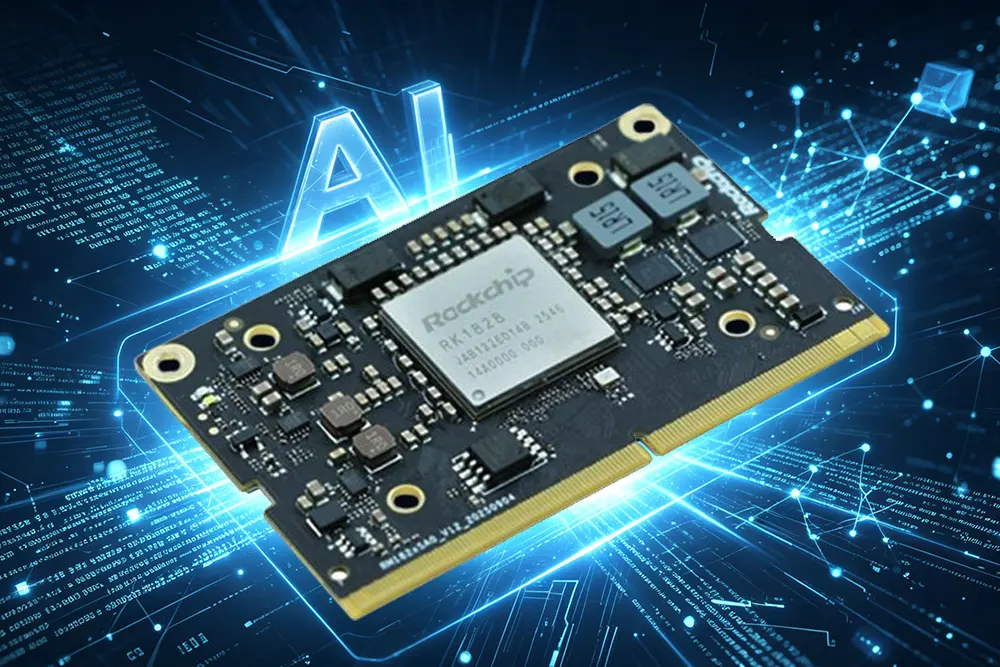
RK1828 Key Specifications
RK1828 is designed as a dedicated AI coprocessor for edge inference workloads.
Key hardware specifications include:
| Feature | RK1828 |
|---|---|
| Process Node | 20nm |
| AI Performance | 20 TOPS (INT8) |
| Precision Support | INT4 / FP8 / FP16 / BF16 |
| Memory | 5GB 3D-Stacked DRAM |
| Memory Bandwidth | 1024GB/s |
| CPU | Triple-core RISC-V 64GCB |
| Interface | PCIe 2.0 x1 / USB 3.0 |
| Typical Power | ~5W |
| Cooling | Passive cooling supported |
| Form Factor | M.2 2280 / SO-DIMM compatible |
| Target Models | Up to 7B LLMs |
Unlike many conventional edge AI accelerators that rely heavily on external LPDDR memory, RK1828 integrates high-bandwidth stacked DRAM directly within the package. This architecture is particularly relevant for LLM inference workloads where memory throughput often becomes the primary bottleneck.
RK1828 vs Orin NX vs Hailo-8 vs RK1820
1. AI Compute and LLM Capability
| Chip | INT8 TOPS | Memory | Target LLM Size | 7B Inference |
|---|---|---|---|---|
| RK1828 | 20 TOPS | 5GB | 7B | 56 tokens/s |
| Jetson Orin NX | 100 TOPS | 8GB LPDDR5 | 7B | 14.5 tokens/s |
| Hailo-8 | 26 TOPS | Host-dependent | ~3B | ~30 tokens/s |
| RK1820 | 20 TOPS | 2.5GB | 3B | 87.7 tokens/s (3B) |
Although Jetson Orin NX delivers significantly higher theoretical TOPS performance, edge-side LLM inference is increasingly constrained by memory bandwidth rather than pure compute throughput.
In bandwidth-heavy 7B inference workloads, RK1828 demonstrates notably higher token throughput efficiency relative to its compute class, especially under low-power embedded deployment scenarios.
2. Memory Bandwidth: The Core Architectural Difference
The most distinctive aspect of RK1828 is its memory subsystem.
| Platform | Memory Architecture | Bandwidth |
|---|---|---|
| RK1828 | 3D-Stacked On-Package DRAM | 1024GB/s |
| Jetson Orin NX | LPDDR5 | 68GB/s |
| Hailo-8 | External host memory | Lower / host dependent |
For modern LLM workloads, memory movement is often more performance-critical than arithmetic throughput itself.
RK1828’s integrated 3D-stacked memory architecture significantly reduces bandwidth bottlenecks commonly observed in LPDDR-based edge AI systems. This becomes increasingly important for:
- 7B parameter LLM inference
- Multi-modal AI pipelines
- Multi-stream video analytics
- Real-time edge reasoning workloads
Rather than competing purely on TOPS, RK1828 appears optimized for sustained data-intensive inference efficiency.
3. Power Efficiency and Thermal Design
Power consumption remains one of the biggest deployment challenges for industrial edge AI systems.
| Platform | Typical Power | Cooling Requirement |
|---|---|---|
| RK1828 | ~5W | Passive |
| Orin NX | 10–20W | Active cooling recommended |
| Hailo-8 | ~2.5W | Passive |
RK1828 operates within a relatively low power envelope while still targeting 7B-class models. This positioning is particularly relevant for:
- Fanless embedded systems
- Industrial automation
- Smart gateways
- Outdoor AI devices
- Unattended edge deployments
Lower thermal complexity can also reduce total system cost and improve long-term reliability in industrial environments.
4. Software Ecosystem and Deployment Flexibility
RK1828 provides a development environment centered around the RKNN3 toolkit, supporting model conversion from major deep learning frameworks including PyTorch, TensorFlow, and Caffe, with a streamlined workflow for edge inference deployment. It also exposes API-compatible inference interfaces designed to simplify integration with existing cloud-native AI application stacks.
In comparison, NVIDIA Jetson Orin NX benefits from a mature and widely adopted software ecosystem, including CUDA, TensorRT, and extensive developer tooling. However, this ecosystem is tightly coupled to NVIDIA’s proprietary stack, which can increase platform dependency and licensing complexity in large-scale deployments.
Hailo-8, on the other hand, offers a more specialized software stack optimized primarily for vision inference pipelines. While efficient for CNN-based workloads, its ecosystem is more constrained in terms of supported model types and general-purpose LLM deployment flexibility.
Potential Edge AI Deployment Scenarios
1. On-Device 7B LLM Deployment
RK1828 is particularly positioned for localized LLM inference workloads such as:
- Edge knowledge assistants
- Offline customer service systems
- Industrial copilots
- Local document summarization
- Private AI agents
A common architecture could combine RK3588 as the host processor with RK1828 as the dedicated LLM acceleration coprocessor.
2. Industrial Vision and AI Inspection
High memory bandwidth also benefits real-time vision applications involving:
- Multi-channel 4K video analysis
- AI quality inspection
- Smart manufacturing
- Edge video analytics
The passive thermal profile further supports deployment in dust-prone or vibration-sensitive industrial environments.
Final Thoughts
RK1828 represents a different design philosophy in edge AI acceleration.
Instead of maximizing peak TOPS alone, the platform prioritizes:
- High-bandwidth memory architecture
- Efficient 7B LLM inference
- Low-power edge deployment
- Fanless industrial integration
For edge AI workloads where memory bandwidth becomes the dominant bottleneck, RK1828 may offer a more balanced architecture than conventional compute-centric accelerators.
As edge LLM workloads move toward on-device deployment, system architectures that optimize memory bandwidth and energy efficiency are increasingly critical for achieving practical inference performance at the edge.