
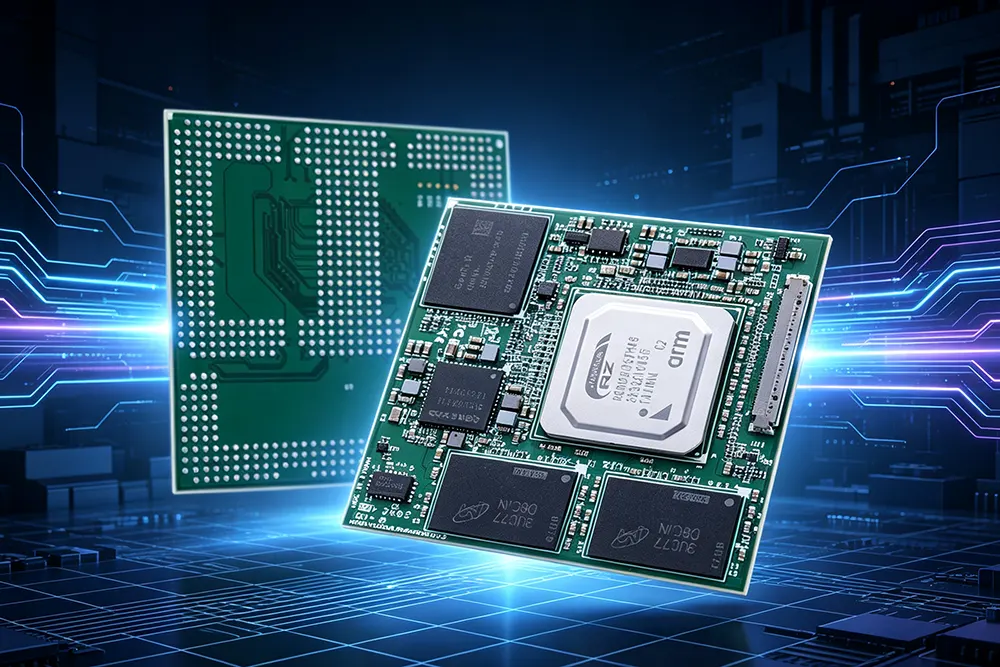
Geniatech introduces its new SOM-V2H-OSM, a AI System-on-Module based on the Renesas RZ/V2H vision AI processor, designed for next-generation edge AI and robotics systems that require real-time perception, decision-making, and control within a unified compute environment.
The introduction comes as edge AI systems increasingly move beyond isolated inference tasks toward integrated architectures where vision processing, AI inference, and motion control must operate simultaneously at the edge.
Edge AI Is Shifting Toward Real-Time Machine Intelligence
In industrial robotics and autonomous systems, system complexity is no longer defined by AI model capability alone, but by the ability to coordinate multiple compute workloads in real time.
Modern machines must continuously interpret multi-sensor inputs, execute AI-driven perception tasks, and maintain deterministic control loops without introducing latency or instability into the system.
Traditional architectures typically distribute these functions across multiple processing units, which increases integration complexity and introduces timing uncertainty at the system level.
RZ/V2H Enables Unified Execution of AI and Real-Time Workloads
The Renesas RZ/V2H processor addresses this challenge through a heterogeneous architecture designed to separate and coordinate different compute domains within a single device.
It combines application processing, real-time control, and AI acceleration in a tightly integrated structure, enabling AI inference and deterministic control workloads to run in parallel without interfering with each other.
Compared to earlier RZ/V series devices such as RZ/V2L and RZ/V2N, which target entry-level and mid-range edge AI applications, RZ/V2H introduces a higher level of AI processing capability through the DRP-AI3 accelerator, significantly expanding the range of vision and inference workloads that can be executed at the edge.
OSM Brings a More Scalable Approach to Edge AI System Design
Alongside silicon evolution, system-level design in edge AI is also shifting toward standardized compute modules that reduce hardware fragmentation and accelerate deployment cycles.
The OSM (Open Standard Module) approach adopted in SOM-V2H-OSM reflects this shift by decoupling compute integration from carrier board design, allowing system developers to reuse the same compute foundation across multiple product generations.
This model improves scalability in industrial deployments where long lifecycle stability and rapid product variation are often conflicting requirements.
From Vision Systems to Intelligent Machines
As edge AI capabilities continue to evolve, system design is increasingly moving from standalone vision processing toward integrated intelligent machines that combine perception, reasoning, and physical actuation within a single platform.
In this context, the SOM-V2H-OSM is designed for applications where real-time environmental understanding must directly translate into system-level responses without relying on external compute resources.
This makes it suitable for robotics, industrial automation, logistics systems, and other environments where machine intelligence must operate continuously and autonomously at the edge.
Expanding a Multi-Platform Edge AI Strategy
The introduction of SOM-V2H-OSM further extends Geniatech’s embedded computing portfolio across multiple semiconductor ecosystems, including solutions based on NXP, Rockchip, Qualcomm, MediaTek, and Renesas platforms.
This multi-platform strategy enables Geniatech to address a wide range of edge computing requirements across different performance tiers, from cost-sensitive embedded systems to high-performance AI and robotics applications.
Availability
The SOM-V2H-OSM is available for evaluation and OEM/ODM integration, with full software and hardware enablement support for industrial edge AI development. More information about Geniatech’s embedded AI platform is available at https://www.geniatech.com