
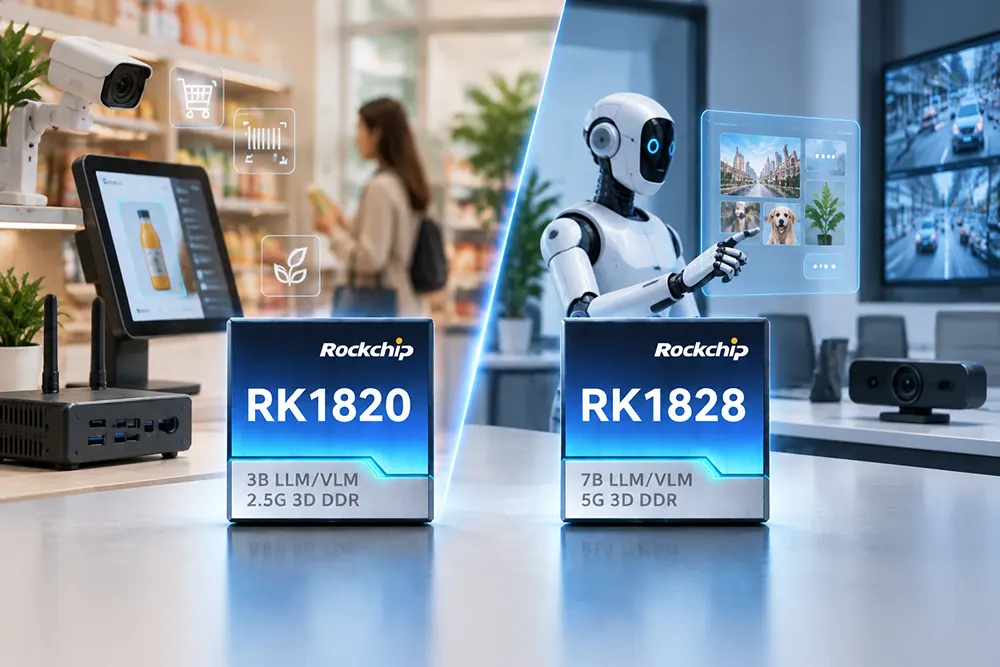
RK1828 and RK1820 are Rockchip’s AI co-processors designed to add dedicated AI inference capability to embedded platforms. While they share the same architecture and 20 TOPS INT8 NPU, the practical difference comes down to one question: what size of AI model do you actually need to run locally?
Quick answer
- Choose RK1820 if your target models stay at 3B parameters or below, you’re running lighter VLMs or traditional CNN detection, and you want to minimize power draw and cost. It also delivers the fastest single-card token throughput of the two on right-sized models.
- Choose RK1828 if you need to run 7B-class LLMs or multimodal VLMs, plan to scale beyond a single card via multi-card clustering (up to 27B-class models), or need headroom for a growing model roadmap.
Where the two chips are identical
RK1820 and RK1828 share far more than they differ on. Both use the same triple-core RISC-V64 scheduling core with FPU, 32KB L1 cache per core, and a shared 128KB L2 cache. Both deliver 20 TOPS INT8 NPU performance with identical precision support (INT4/INT8/INT16/FP8/FP16/BF16, plus W4A16). Both include the same RGA 2D acceleration and 4K JPEG codec (up to 8192×8192), the same security engine (AES/SM4/SHA/RSA/ECC/SM2, OTP encryption), the same host interface set (PCIe 2.0 x1 dual-lane, USB 3.0, Gigabit RGMII, UART/SPI/I2C/GPIO), the same external storage options (SPI Flash, eMMC 4.51, SD 3.0), the same industrial operating range (-10°C to +55°C), and the same M.2 M-Key / SODIMM pin-compatible form factor.
In practice, this means a board designed for one can typically accept the other without a respin — the differentiation is entirely in memory capacity and the model classes that unlocks.
The core difference: memory capacity and target model size
| RK1820 | RK1828 | |
|---|---|---|
| Positioning | Edge AI co-processor for 3B-class LLM/VLM | Edge AI co-processor for 7B-class LLM/VLM, with multi-card clustering for larger models |
| Built-in DRAM (3D-stacked) | 2.5GB | 5GB |
| Typical target model | Qwen2.5-3B; lightweight VLMs; CNN detection | Qwen2.5-7B; 7B-class multimodal VLMs; multi-card clustering up to ~27B |
| Typical power (inference load) | ~8-12W | ~10-14W |
| Best-fit scenario | Budget-constrained deployments, 3B-and-under models, multi-stream vision/analytics, gateway-level AI acceleration | 7B-class models, multimodal workloads, multi-card scaling, complex agent-style on-device applications |
When 3B is actually enough — and when it isn’t
A 3B model isn’t a compromise for every use case. For structured tasks with a narrower scope — intent classification, short-form summarization, simple conversational gateways, or CNN-based detection layered with a small language model for alerts — a well-tuned 3B model on RK1820 can match the practical output quality of a 7B model at a lower cost and power envelope, while running faster.
Where 3B starts to fall short is open-ended reasoning, longer-context document work, and multimodal tasks that require the model to hold more context or handle more varied inputs — the classes of task 7B-parameter models are trained and evaluated on. If your product roadmap includes open-ended chat, document Q&A, or multimodal reasoning beyond simple image-text pairing, budgeting for RK1828 from the start avoids a hardware swap later.
Multi-card scaling: RK1828’s growth path
One structural difference doesn’t show up in the single-card spec table: RK1828 supports multi-card clustering to reach roughly 27B-class model capacity, while RK1820’s role in this comparison is scoped to single-card, 3B-and-under deployment. For products with a roadmap that might grow past 7B — more capable on-device assistants, more complex agent workflows — designing around RK1828 keeps a scaling path open without re-qualifying a different chip family later. RK1820 doesn’t carry this same clustering role in Rockchip’s current lineup, so it’s the right choice when the ceiling is genuinely 3B, not a stepping stone toward something larger.
Decision guide by workload
| Workload | Recommendation | Why |
|---|---|---|
| 3B-class chat, intent classification, simple summarization | RK1820 | Best throughput and lowest power for right-sized 3B models |
| Lightweight VLM (image + short text) | RK1820 | 2.5GB DRAM comfortably serves smaller multimodal models |
| Multi-stream CNN detection + light LLM alerting | RK1820 | Cost and power headroom for combined vision + language tasks |
| 7B-class chat or document Q&A | RK1828 | 5GB DRAM sized for 7B working sets |
| 7B-class multimodal VLM | RK1828 | Larger memory pool needed for combined vision-language context |
| Roadmap likely to scale past 7B | RK1828 | Multi-card clustering path to ~27B-class models |
| Budget- or power-constrained gateway deployment | RK1820 | Lower typical power draw (~8-12W vs ~10-14W) |
FAQ
Can I swap RK1820 and RK1828 on the same board design?
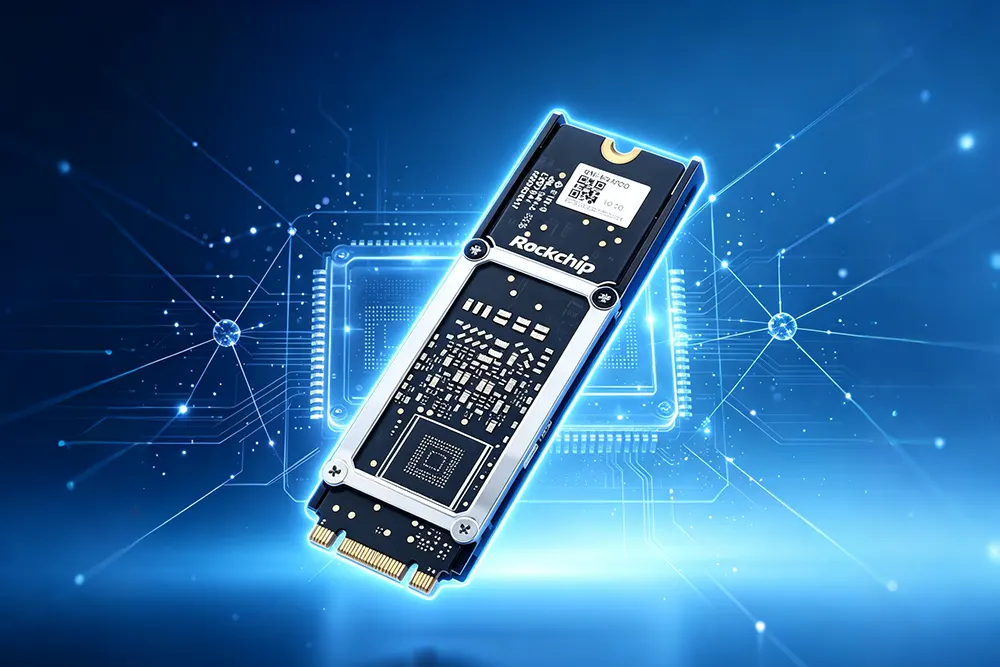
In most cases, yes. Both share the same M.2 M-Key / SODIMM pin-compatible form factor, the same PCIe 2.0 x1 dual-lane and USB 3.0 host interfaces, and the same CPU architecture. The practical constraint is memory-dependent software behavior — a design tuned for a 7B model on RK1828 won’t perform the same if swapped to RK1820’s smaller DRAM pool, so the swap works at the hardware level but still needs model-side validation.
Is RK1828 always the safer choice if I’m not sure which model size I’ll need?
Not necessarily. If cost and power are tightly constrained and your model requirements are genuinely capped at 3B, RK1820 is the better fit and avoids paying for headroom you won’t use. RK1828 is the safer choice specifically when there’s real uncertainty about scaling past 7B down the line.
Do RK1820 and RK1828 support the same AI frameworks and toolchain?
Yes — both are part of the same Rockchip RKNN3-based toolchain and support the same precision formats (INT4/INT8/INT16/FP8/FP16/BF16, W4A16), so model conversion and deployment workflows carry over between the two.
Getting to hardware
For teams building a complete edge AI system rather than sourcing individual modules, Geniatech’s upcoming RK3588 + RK1828 edge computing box pairs the two chips into a ready-to-deploy platform for offline LLM and VLM inference — no board design or module integration required. For projects that need the module-level flexibility to design RK1820 or RK1828 directly into a custom RK3588, RK3576, or RK3568 platform, Geniatech also offers both as standalone M.2 Computing Cards, including drop-in compatibility with SOM3588.