
Over the past two years, something big has changed in AI.
Large language models (LLMs) and multimodal models (VLMs) are no longer trapped in massive data centers. Thanks to smarter optimization techniques, smaller 1–7B parameter models can now run smoothly on lightweight, low-power hardware—even on single-board computers or embedded devices.
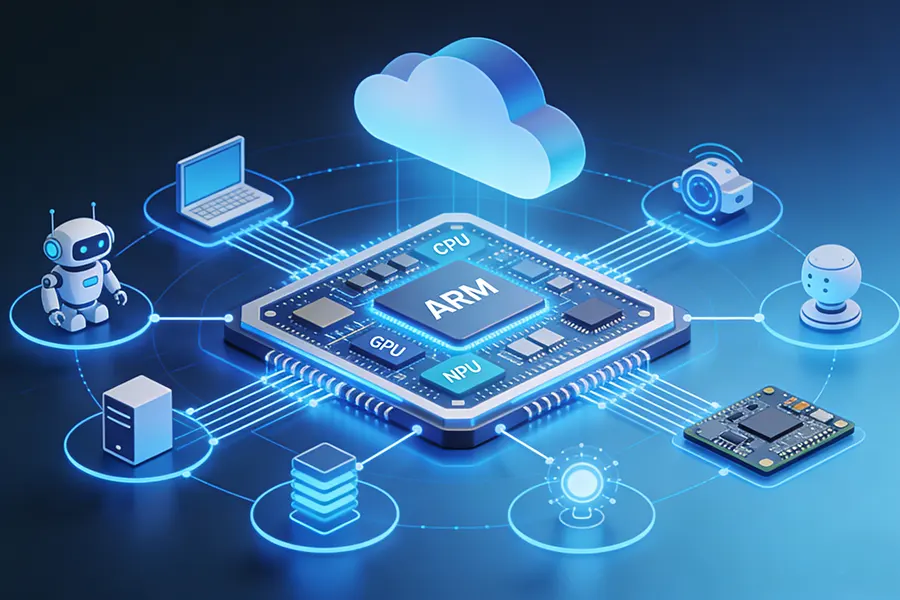
This shift opens huge opportunities for engineers building real-world products. And right at the center of it all is ARM—long the “low-power” champion, now emerging as the go-to architecture for efficient, edge-native AI systems.
Why AI Is Moving From Cloud to Edge
Running AI in the cloud used to be the standard, but the game has changed.
Modern AI applications need:
- Lower latency for real-time robotics, retail, inspection, and interactive systems.
- Lower costs, since cloud inference scales up in price quickly.
- Better privacy, keeping sensitive images, voice, or sensor data on the device.
- Higher reliability, so systems keep working without constant connectivity.
- Smaller models, optimized to run on the edge through quantization.
These shifts make ARM architectures almost tailor-made for the new generation of embedded AI.
Why ARM Fits the Edge AI Era
ARM’s strengths—efficiency, integration, and flexibility—match edge AI perfectly.
1. Power Efficiency
Running LLMs in fanless, low-power environments is hard. ARM’s heterogeneous compute architecture — CPU + GPU + NPU + DSP — delivers top performance per watt, scaling from 5W to 15W without breaking thermals.
2. Integration for Real-World AI Pipelines
ARM-based SoCs pack everything needed for multimodal AI:
- NPUs for neural compute
- ISPs for camera input
- VPUs for video decoding
- GPUs for graphics or ML
- Rich I/O support (CAN, MIPI, UART, PCIe, etc.)
That means less board complexity and shorter development cycles.
3. Existing Industrial Presence
ARM already dominates industrial and embedded markets—smart factories, robotics, automotive, medical, and IoT systems.
These sectors value stability, longevity, and power efficiency, the exact qualities that define ARM.
Model Optimization Makes Edge AI Practical
What once required racks of GPUs now fits into compact embedded systems. The reason? Smarter model compression and deployment techniques.
- Quantization (INT8, INT4, ternary) reduces model size drastically with minimal accuracy loss.
- KV-cache optimization keeps memory needs low during streaming inference.
- Low-Rank Adaptation (LoRA) allows lightweight fine-tuning on small devices.
- Multimodal compression enables vision + language models to run under 15W.
In short, workloads that once demanded datacenter GPUs now fit inside compact ARM-based systems.
The New Generation of ARM SoCs
ARM chip families built for AI are flooding the market — powerful, efficient, and ready for inference out of the box.
- Rockchip RK3588 / RK3576 – Up to 10 TOPS NPU, powerful Cortex cores, great for industrial AI boxes.
- NXP i.MX 9 – Industrial-grade platform with strong vision and speech acceleration.
- Qualcomm QRB/Robotics Platforms – High-frequency CPUs, efficient GPUs, and AI engines for real-time inference.
- NVIDIA Jetson Orin Nano – ARM CPU + NVIDIA GPU combo, excellent for robotics and multimodal AI.
The trend is clear: NPUs are becoming the heart of the chip, not the CPU.
ARM + AI Accelerators: A Perfect Combo
For more demanding use cases—like 7B model inference or multi-camera analytics—adding external accelerators can offer big benefits.
Popular choices include:
- Hailo-8 / Hailo-10 – Exceptional power efficiency (TOPS/W).
- Kinara Ara-2 – Scalable inference for language and vision.
- DEEPX – High-performance inference with class-leading efficiency across vision and speech workloads.
- MemryX MX3 – Flexible edge accelerator with strong support for diverse AI models and ultra-low-latency inference.
These accelerators come in M.2, PCIe, or LGA modules and can be easily integrated with ARM systems, leading to faster, more flexible, and more scalable designs.
How to Choose the Right ARM Hardware
Selecting ARM hardware for AI isn’t just about core counts or TOPS. It’s about how everything works together in the real world.
1. NPU Performance vs. Actual Model Needs
Check how your specific model runs, not just the benchmark. A 7B LLM behaves very differently from a compact 1B model under the same hardware.
2. Memory Bandwidth
LLMs crave memory speed.
- Less than 2GB: Too small.
- 4–8GB: Fine for 1–3B models.
- 8–16GB: Okay for 7B models.
- 16GB+: Needed for Multimodal or multi-video stream workloads.
3. Thermal Design
LLMs generate heat fast. Ensure your system can maintain sustained performance in fanless or hot environments.
4. Software Stack
A great SoC is useless without a mature SDK.
Look for ONNX Runtime, TensorFlow Lite, PyTorch Edge, TVM, or vendor SDKs like RKNN Toolkit, HailoRT, Kinara SDK, or NXP eIQ.
A stable compiler determines how easily your model deploys.
5. Lifecycle & Reliability
For industrial products, long-term availability (10–15 years) and robust design outweigh pure performance. ARM vendors handle this well.
Real-World Applications
ARM-based AI systems are already transforming industries:
- Industrial automation – Vision inspection, predictive maintenance, local LLMs for human-machine interaction.
- Smart retail – In-store analytics, customer interaction kiosks with speech AI.
- Transportation – Driver monitoring, passenger analytics, and voice-control systems.
- Healthcare – Diagnostics, visual analysis, patient-assist devices.
- Energy & utilities – Remote monitoring, anomaly detection, offline inference in harsh conditions.
Choosing Between ARM and ARM + Accelerator
Go with ARM SoC only if:
- Power budget is under 10W.
- You’re running small 1–3B LLMs.
- Workloads are predictable.
- Cost and simplicity are priorities.
Go with ARM + Accelerator if:
- You need 10–50+ TOPS.
- Running 3–7B models at usable speed.
- Handling multiple cameras or multimodal input.
- You want modular scalability.
ARM Has Become the New Default for Edge AI
As models move closer to the physical world, the design priorities shift. It’s no longer about raw CPU power—it’s about total AI system efficiency.
Key design factors now include:
- NPU throughput
- Memory bandwidth
- Thermal efficiency
- Accelerator integration
- Software ecosystem
- Long-term reliability
ARM stands right at this intersection: efficient, flexible, and ready for the edge-native future of AI.